What's the Difference Between a 3D Virtual Tour and a 360-Degree Tour for Real Estate?
In today's competitive real estate market, visually engaging listings are essential for attracting potential buyers and renters. With a growing array of digital tools available, understanding the nuances between different immersive experiences can be challenging. Two popular options, 3D virtual tours and 360-degree tours, often get confused, yet they offer distinct experiences and benefits.
This article aims to clarify the differences between these two powerful visual marketing tools, helping real estate professionals make informed decisions about which best suits their listings and marketing goals.
Direct Answer: Understanding 3D Virtual Tours vs. 360-Degree Tours
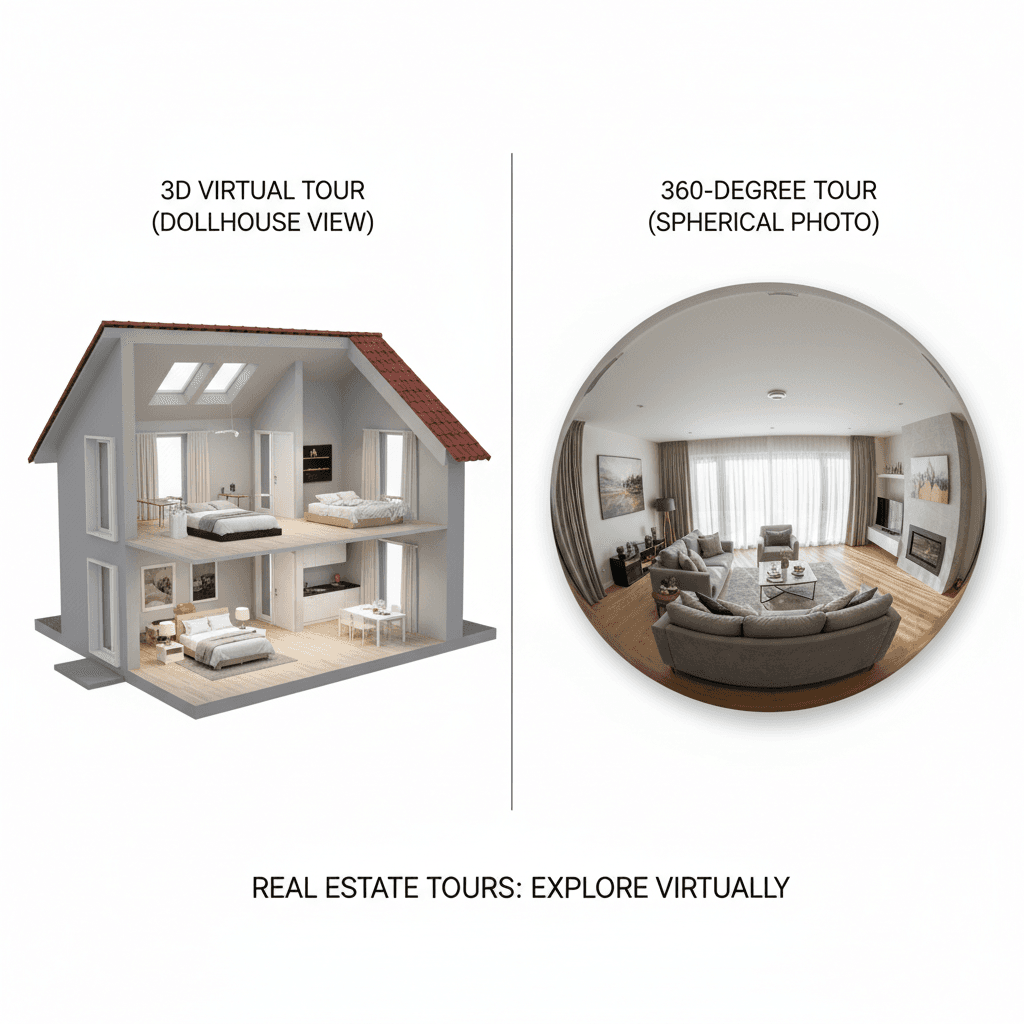
While both offer interactive ways to explore a property virtually, a 3D virtual tour (often referred to as a "dollhouse" tour, like those created with Matterport) provides a fully navigable, three-dimensional model of a space. Users can move freely through rooms, look at spaces from any angle, and even view an entire floor plan from above, giving a genuine sense of spatial relationship and depth. It's akin to walking through the property in a video game.
In contrast, a 360-degree tour (sometimes called a panoramic tour) is a collection of static, spherical panoramic photos linked together. Viewers can click from one point to another within the property and look around 360 degrees from each fixed viewpoint. While immersive from a single spot, it lacks the seamless, fluid navigation and true spatial awareness that a 3D model offers. Think of it as a series of high-resolution, interactive snapshots rather than a complete 3D environment.
Why This Matters for Real Estate Listings
Choosing the right type of virtual tour significantly impacts a listing's effectiveness. A 3D virtual tour offers an unparalleled level of immersion and detail, allowing prospective buyers to truly understand a property's layout and flow without a physical visit. This can lead to more qualified leads, reduced showing times, and quicker sales, as buyers have a clearer picture before stepping foot inside. It builds greater confidence and allows for detailed pre-screening.
A 360-degree tour, while less interactive, still provides a far superior experience to static photos. It's an excellent option for properties with simpler layouts or when budget is a primary concern. It allows agents to showcase specific areas comprehensively and is a great stepping stone for buyers to get a better feel for the property's ambiance. Both options extend a property's reach beyond local boundaries, attracting a wider audience.
Common Mistakes Agents Make
Real estate agents sometimes make critical errors when implementing virtual tours:
- Interchangeable Terminology: Referring to a 360-degree tour as a "3D tour" can set inaccurate expectations for potential buyers, leading to disappointment.
- Mismatching Tour Type to Property: Using a complex 3D tour for a small, straightforward studio might be overkill, while a simple 360-degree tour for a multi-story home with intricate layouts might not provide enough detail.
- Poor Integration: Not prominently featuring the virtual tour link on MLS listings, property websites, or social media reduces its impact and discoverability.
- Neglecting Quality: A poorly lit, blurry, or badly stitched virtual tour (of either type) can detract from a property's appeal, doing more harm than good.
- Underestimating Preparation: Assuming the property doesn't need to be staged or decluttered just because it's a virtual viewing. Clutter is still visible and distracting.
How Professionals Approach This Differently
Professional real estate photographers and visual content creators take a strategic approach to virtual tours:
- Strategic Consultation: They assess the property type, target audience, and marketing budget to recommend the most suitable virtual tour solution, whether it's a full 3D model or a high-quality 360-degree tour.
- Specialized Equipment: Professionals utilize high-resolution 3D cameras and scanners (for 3D tours) or professional DSLR cameras with panoramic heads (for 360-degree tours) to capture crisp, detailed imagery.
- Expert Processing: Advanced software and skilled technicians are used for precise stitching, color correction, and optimizing navigation paths, ensuring a seamless and visually appealing experience.
- Enhanced Features: They can often integrate additional elements like interactive floor plans, embedded tags for key features, and lead capture forms directly into the virtual tour interface.
- Consistency and Branding: Ensuring the virtual tour aligns with the overall listing presentation and agent branding, maintaining a high standard of visual quality across all marketing materials.
Dooorbells offers comprehensive visual marketing solutions, including both immersive 3D virtual tours and high-quality 360-degree tours, helping agents present their listings effectively and attract more qualified buyers.
Related Topics
Explore more insights on these related topics: